Thursday, March 13, 2008

Think you have an ITAR issue? Protect yourself, experts say


Posted by John Keller

Component suppliers who even suspect that their products might be designed into military systems need to take steps to protect themselves from potential violations of International Traffic in Arms Regulations (ITAR). If they don't, they risk serious trouble.

I'm not talking about just fines; I'm talking about losing your company. The bottom line is protecting yourself. This is risky -- to the point that in extreme circumstances you could be working at Wendy's the next day, warns Dean Young, facilities security officer for Celestica Aerospace Technologies in Austin, Texas.

Young made his comments Wednesday in a panel discussion at the Military & Aerospace Electronics Forum (MAEF) conference and trade show in San Diego, which concluded Wednesday afternoon.

Component suppliers should be on guard for ITAR issues, particularly if they are doing business with the large prime defense contractors. Most of these large companies have ITAR organizations in place to help their suppliers navigate often-treacherous ITAR waters, but sometimes problems can occur, experts admit.

Prime defense contractors are very sensitive about releasing details about whose products they are using, and in which applications -- sometimes to the degree that individual engineers or program managers inside these companies might be reluctant to tell even the suppliers of the components where these devices are going.

If this happens, push back and get enough information to protect yourself, panelists told MAEF attendees. Don't accept "we're not telling," or "mind your own business," from customers -- ever.

If that kind of thing happens, such as if a person at a prime contract is being difficult or is overly concealing information, "I would like to know about it," says Karen Jones, director of export import operations at Raytheon Missile Systems in Tucson, Ariz.

In addition to Young and Jones, other panelists were Kay Georgi, partner at the law firm of Arent Fox LLP in Washington, and Lawrence Fink, director of corporate export administration at Science Applications International Corp. (SAIC) in San Diego.

Component suppliers need to get smart about ITAR guidelines; they need to get smart fast before they get into trouble. It can be a matter of protecting yourself, your family, and your company.

It may even involve the potential of walking away from revenue if a supplier simply cannot get the information he needs to protect himself, experts say.

At the same time, suppliers should be as tactful and as partnering as possible when they approach their prime-contractor customers so they don't risk killing their business or relationships.

For more information, panelists recommend a pamphlet on Project Shield America from the U.S. Department of Homeland Security's investigative bureau of Immigration and Customs Enforcement (ICE) in Washington.

Project Shield America is an industry outreach program to prevent the illegal export of sensitive U.S. munitions and strategic technology to terrorists, criminal organizations, and foreign adversaries.

To learn more about the Project Shield America pamphlet, contact ICE online at www.ice.gov.

Tuesday, March 11, 2008

Military radio communications designers need to build a better mouse trap


Posted by John Keller

SAN DIEGO -- Military radio designers need to give more thought to how they blend RF and microwave components with digital circuitry in new generations of software-defined radio, says one of the Pentagon's top communications executives.

The problem revolves around radio designs that tightly couple the RF section and digital sections. This can slow down design and production, and create huge headaches when it comes to technology insertion and systems upgrades, says Dr. Ron Jost, the DOD's deputy assistant secretary of defense for C3.

"Please don't tightly couple the RF to the digital sections in the radio," Jost said today in a keynote address at the Military & Aerospace Electronics Forum (MAEF) conference and trade show in San Diego. "The RF won't change much; it's the digital that will change."

In the interests of full disclosure, I need to point out that the MAEF is sponsored by Military & Aerospace Electronics magazine.

Jost told MAEF attendees that digital circuitry goes obsolete very quickly -- as often as once a year -- and tightly coupling the RF to digital often is problematic.

Instead, Jost suggests that radio designers create more modular communications architectures where digital circuitry easily can be swapped out as it goes obsolete, but that leaves the longer-lasting RF and microwave sections alone.

Evidently this is among the reasons that the Pentagon's Joint Tactical Radio System (JTRS) program is in trouble.

Radio designs are not the only problems facing the Pentagon's communications planners, Jost points out. Senior Defense Department planers are well along in network management, yet what they need now is spectrum management. He's asking for the defense industry's help to do this.

"We are going to put together a complete spectrum-management tool and network-management tool for the Department of Defense, and we need your guys's help," Jost told MAEF attendees this morning. "The warfighter can't do it with what we're giving him today."

Monday, March 10, 2008

Now it's not just talk: VPX embedded computing starts racking up design wins


Posted by John Keller

For more than a year now we've been hearing about the latest flavor of VME embedded computing. The newest incarnation is called VPX, and relies on a variety of high-speed serial fabric networking approaches, rather than the traditional parallel VME databus.

Until now, VPX, formerly known as VITA-46, largely has been a technology in search of an application. It had been criticized for being a bleeding-edge technology that had more industry enthusiasm than real markets, and some in the embedded computing industry thought it might never really take off.

That was then, this is now.

VPX is starting to rack up what many believe will be a long string of design wins. This technology is no longer just marketing talk; it's a validated technology with real military customers.

Just today, Curtiss-Wright Embedded Computing in Leesburg, Va., announced that it is providing VPX-based radar signal processing for the U.S. Marine Corps Ground/Air Task Oriented Radar (G/ATOR) program. Other design-ins are expected to be announced soon.

Stay tuned for more on VPX.

Thursday, March 6, 2008

Chinese company doesn't operate the Panama Canal ... just both ends of it


Posted by John Keller

I must correct a mistake I made in a blog entry earlier this week entitled Back to the jungle: would U.S. intervene if war comes to South America? In this blog I stated that Panama Canal operations are managed by a company with close ties to the Chinese government. This is an error, which Teresa Arosemena, international communications manager for the Panama Canal Authority, pointed out to me this week in a very polite e-mail.

It is the Panamanian government, through the Panama Canal Authority, that operates the Panama Canal, not a company with ties to the Chinese government, and I sincerely regret the error.

My reason for bringing up the issue of Panama Canal operations revolves around military tensions on the Colombia/Venezuela border, which could lead to a war in close proximity to the Panama Canal -- a strategically important asset to the United States and other Western powers -- as I pointed out in the blog.

More to the point, I mused in the blog whether a Colombia-Venezuela war could drag the United States and China into confrontation in the region. The U.S. is a staunch ally of Colombia, while China is allied with Venezuela. Concerning the Canal, China has interests there, too.

While actual Canal operations are in the hands of the Panamanian government, a Hong Kong-based company, Hutchison Whampoa Ltd., which reportedly has ties to the government of the People's Republic of China and its military, operates the port facilities on either end of the Panama Canal.

I bring up these facts out of concern for the potential disruption of Panama Canal traffic should the U.S. or its allies come into military confrontation with China. How likely is this? I couldn't say, but it would be exceedingly easy for Chinese agents working through Hutchison Whampoa to halt, slow, or otherwise disrupt Panama Canal shipping traffic if it came to that. The potential is there.

The Panama Canal is of the utmost strategic importance to the United States, as it enables the U.S. Navy to transfer its forces rapidly between the Pacific and Atlantic theaters. The potential for Canal disruption is of dire concern to U.S. military authorities.

It was never my intention to link the Panama Canal Authority with the government of China. I believe no link exists. Hutchison Whampoa operates other port facilities in the Western Hemisphere, in addition to Panama.

I retain my concern, however, that a Chinese company effectively controls the entrances and exits of the Panama Canal at a time when U.S. and Chinese national interests could come into conflict just a couple of hundred miles away.

Wednesday, March 5, 2008

Java, anyone?

Posted by Courtney E. Howard

"What is the deal with COTS components in mil-aero embedded software?" Sorry to wax nostalgic there, with my spot-on impression of Jerry Seinfeld ... My likely feeble attempt at humor aside, I do have a valid question or two about the use of open-source code and software components in military and aerospace applications.

I talk to a great deal of industry pundits, and conflicting viewpoints abound with regard to commercial components (including open-source code and Java, C, and C++ programming languages, as examples) in mil-aero software solutions.

Some say the use of Java and open source in mil-aero applications is widespread. Others say both are not accepted in mil-aero projects. Some say no open source code, especially of questionable origin, should be used in mil-aero. Open source proponents profess the time and cost savings, the expanded feature sets, and the community of thousands upon thousands of developers and programmers constantly working on and improving software components. Some believe Ada is the only way to go, others rely on Java and look forward to the upcoming release of a secure version.

What say you?

I invite you to share your input, insights, comments, questions, and experiences -- here, in our forum. If you'll be at the Military & Aerospace Electronics Forum in San Diego next week, perhaps we can discuss it over some java (pun intended).

Tuesday, March 4, 2008

Find me a safe harbor from 'forward-looking statements' ... please!


Posted by John Keller

My wife, a wise woman, warned me that at around age 50 I would look around at the world I inhabit and find an alien landscape. Well, I'm nearly 49, and I barely recognize anything.

I remember television in a major metropolitan area with only seven channels. I remember conducting business without cell phones, personal computers, or the Internet. Most notably I remember news announcements without "safe harbor statements" and "forward-looking statements."

I know the lawyers have taken over pretty much everything, but I think the lunatics are running the asylum, and have been doing so for much longer than I have taken notice of it.

I've been looking at press announcements almost every day of the nearly 27 years that I've been a professional news reporter. Add in my years as a high school and college journalist and ... I don't even want to think about it. New stuff creeps in over time that I barely notice, but I've reached my limit.

I'm routinely getting news announcements these days in which more than half the text is the so-called "safe harbor statements" and "forward-looking statements." I just got one yesterday that was 335 words long. Often my entire news stories contain fewer words than that.

What are these things, you might ask. I think they're mostly legal fig leaves intended to shield companies from litigation, as per the Private Securities Litigation Reform Act of 1995.

In other words, it's like a lot of things these days designed to stave-off lawsuits -- like warning people that coffee is hot, high-calorie foods can make you fat, and cigarettes can kill you. Is this news to anyone?

Well, the 335-word forward-looking statement I got yesterday has three core points. I hope you're sitting down because these are Earth-shattering revelations:

1) some of the things we say here are not necessarily historical facts;
2) some of the things we say here are guesses that might not turn out like we think they will; and
3) business is risky; real-life can sometimes get in the way.

I, for one, am shocked ... SHOCKED ... to hear that guesswork and risk are part of doing business. I never would have known, had this forward-looking statement neglected to tell me so.

Seriously, though, is all this really necessary? Please, find me a safe harbor from all these forward-looking statements.

Monday, March 3, 2008

Back to the jungle: would U.S. intervene if war comes to South America?


Posted by John Keller

Here's a potential new spin on Hillary Clinton and her red-phone television commercials. If there's a global emergency in the offing, it might not be in Central Asia, where everyone expects it to be. It could be right here in our own hemisphere.

War might be coming to South America.

Venezuela President Hugo Chavez has ordered 10 tank battalions to his border with Columbia, and put his air force under emergency standby, according to a story in the Daily Mail of London entitled U.S. could intervene as Chavez prepares for war on Columbia. Venezuela also has closed the Columbian embassy in its capital of Caracas.

Chavez, it seems, objects to Columbia's sending soldiers into neighboring Ecuador to fight guerilla soldiers hostile to the Columbian government. Chavez, moreover, is telling Columbia not to chase anti-Columbia guerrillas into Venezuela, warning that such an act would be "cause for war."

Let's remember that the Venezuela-Columbia border is just a thousand miles south of Miami, and less than 500 miles from the strategically important Panama Canal. Could the U.S. stand by if Columbia and Venezuela were to go to war? I think the answer is, probably not -- especially if such a war were to escalate quickly.

Columbia borders on Panama, and is only about 150 miles from the Panama Canal at its closest point. The Canal is one of the most strategically important places in the world. It is key to U.S. capability to move naval forces quickly between the Atlantic and Pacific oceans.

There is little doubt that the United States would intervene quickly in any conflict if U.S. access to the Canal were threatened. Chances of U.S. intervention lessen if the Canal is not part of the equation, yet Venezuela's oil reserves, which many consider to be a strategic asset, undoubtedly will play a role in U.S. decision making.

That's just what we would need -- an armed conflict in the tropical jungles of South America, just as the U.S. seems ready to start drawing down its military commitment in Iraq. It's interesting to glance at the world map and notice that northern Columbia and Venezuela are roughly at the same latitude as Vietnam.

Maybe this speculation is all for nothing; I hope it is. U.S. officials point out that Hugo Chavez is notorious for making wild threats. Perhaps he has no intention of going to war. If he does, though, it won't be pretty.

Now let's add another twist to the mix. Panama Canal operations are managed by a company with close ties to the Chinese government. China is an ally of Venezuela, and China is in desperate need of oil sources to maintain its rate of economic growth. Is it possible that an escalating war between Columbia and Venezuela might bring the U.S. and China into some form of conflict? I think I'd better quick speculating right here.

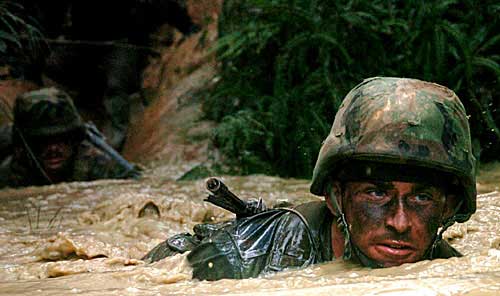
The accompanying photo is of U.S. Navy Petty Officer 3rd Class Jordan Mann, a Seabee assigned to Naval Mobile Construction Battalion 40, low-crawls through a pond during the endurance course at the Jungle Warfare Training Center at Camp Gonslaves, Okinawa, Japan. U.S. Navy photo by Petty Officer 3rd Class John P. Curtis.